Our story
Siva Derm has been made in Alanya, on Turkey's Mediterranean coast, since 2010. Behind the brand is Pyramed, one of the first makers to bring colloidal silver water to a wider public in Turkey.
How it all began
It started with a simple idea: a care product made only of what it really needs. Kemal Tuna, author of the book “Gümüş Suyu”, and the team at the Pyramed Center in Alanya developed a process for making silver water of consistent quality. The brand was registered in 2009 and production began in 2010.
Over the years, that one product has grown into a small care range: spray, refill bottle, cream, intimate care, soap, shampoo and, most recently, colloidal gold water. The thinking has stayed the same: few ingredients, but the right ones.
What we stand for
Honesty
We say what is in the bottle and promise nothing we cannot keep.
Care
Every batch is tested, labelled and archived with a retained sample.
Environment
We generate our electricity with our own solar installation. We bottle in glass, and the big bottle is made for refilling.
Respect
No animal testing. Fair wages for the people who make our products.
A look inside our production
Our production in Alanya is small, and that is on purpose. Filling, labelling and packing are done by hand, under hygienic conditions. We produce continuously to meet demand rather than for stock.
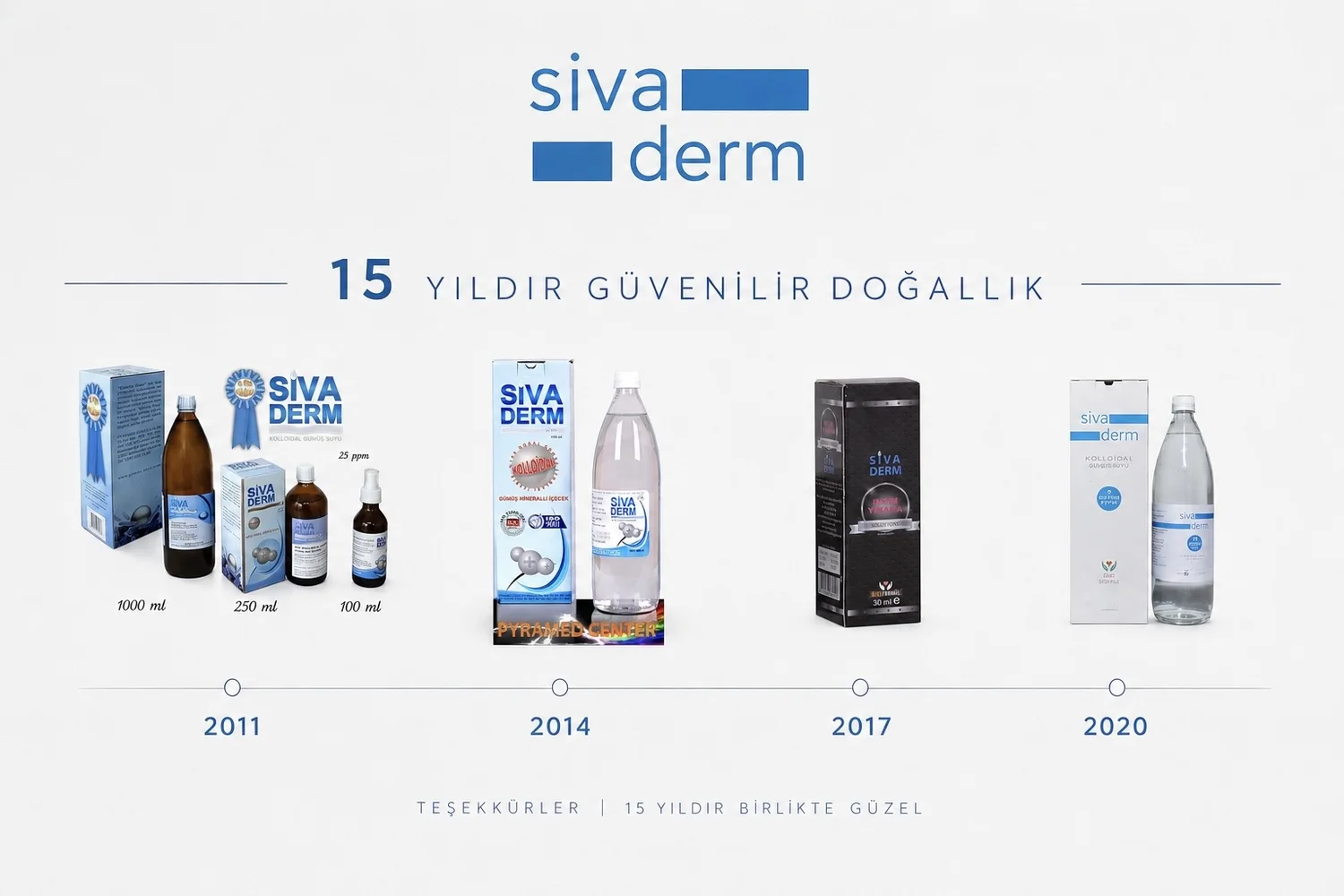
The bottle through the years
From the first bottles in 2010 to today's glass bottle: the packaging has changed, the formula has stayed the same.
Silver: a long history
Silver has accompanied people for more than two and a half thousand years: as a vessel at royal courts, a spoon in the cradle, a bottle on the pharmacy shelf and a piece of technology on board space stations. The timeline below tells what people did with silver in their own day, what they attributed to it and what they made of it. It is cultural history, not a statement about effects.
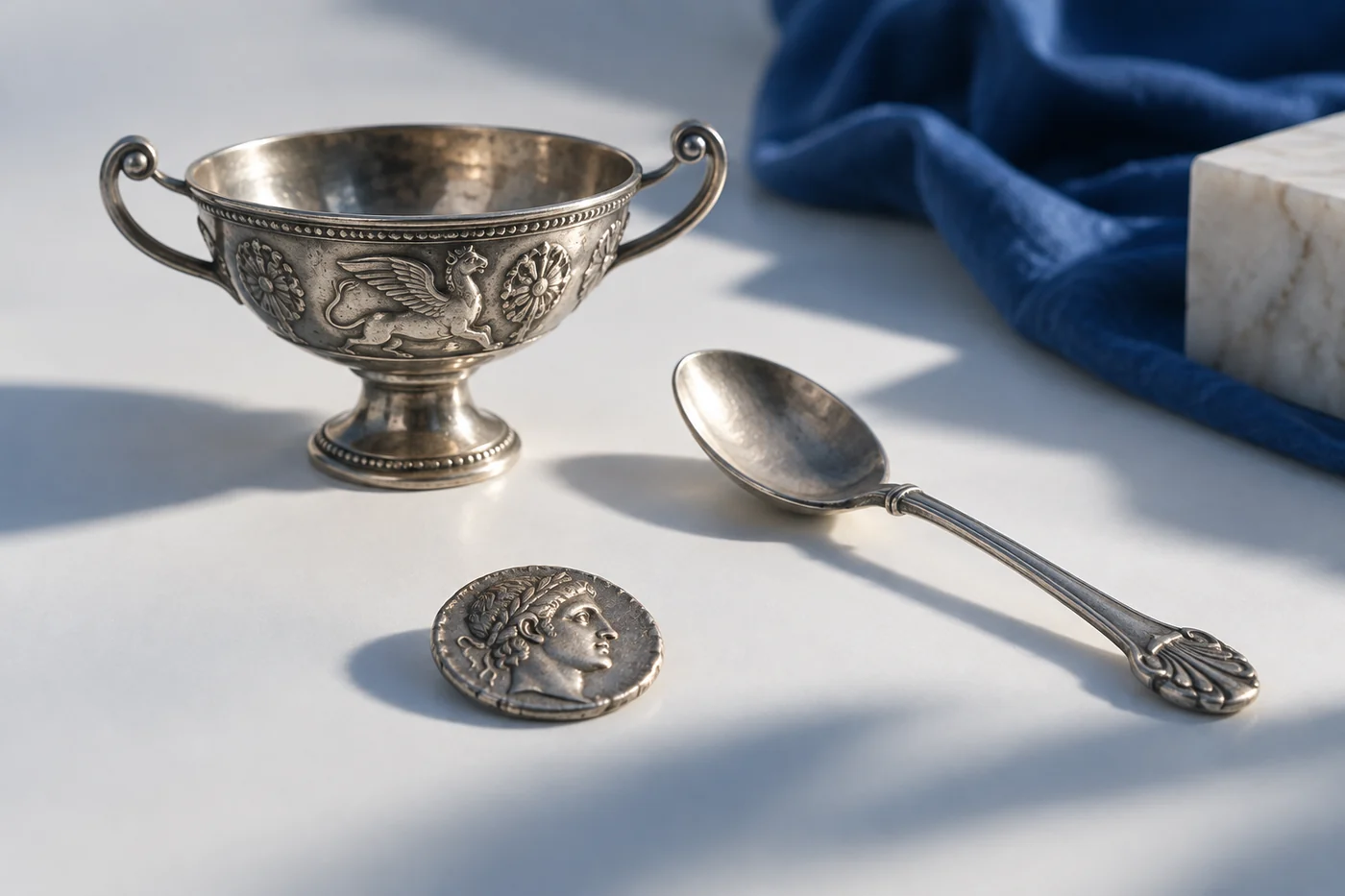
The Greek historian Herodotus tells of the Persian Great King, who on campaign drank only water from the River Choaspes near Susa. It was boiled and carried in silver vessels on four-wheeled mule wagons wherever the king went. It is one of the oldest written accounts of silver as a container for drinking water.
Silver also appears in Greek and Roman medicine. Reviews of medical history cite Hippocrates, who is said to have used silver leaf in wound care. Pliny the Elder mentions silver in Book 33 of his Natural History as an ingredient for plasters. In wealthy Roman households, silver tableware was simply good form.
Those who could afford it ate from silver plates with silver spoons. Silverware was an investment, a status symbol and table culture all at once. There is also the custom, handed down among sailors and travellers, of dropping a silver coin into the water or milk barrel so that the contents would stay fresh for longer. It has come down to us as a story, not as a measurement.
Peter Motteux's English translation of Don Quixote states in print as early as 1712 that not every man is born with a silver spoon in his mouth. Behind it lies an English custom: godparents gave the child a silver spoon at the christening. To this day the phrase stands for a childhood spent in wealth.
The Scottish chemist Thomas Graham studies how dissolved substances travel through membranes. Some pass quickly and crystallise, others move slowly and do not. For the second group he coins the word colloid, from the Greek kólla for glue. Finely dispersed matter in liquids now has a name for the first time, and Graham has been regarded as the father of colloid chemistry ever since.
The Leipzig obstetrician Carl Siegmund Franz Credé publishes his method of placing drops of a two per cent silver nitrate solution in the eyes of newborns straight after birth. Credé's prophylaxis becomes delivery-room routine in many countries and remains so for around a hundred years. Only in the 1980s do other preparations replace it in many places.
His son, the surgeon Benno Credé, brings colloidal silver into medical practice. The preparation is made under the name Collargol by Chemische Fabrik von Heyden in Radebeul, joined by a silver ointment, Unguentum Credé. Doctors in several countries try Collargol and report on it in their professional journals.
In Philadelphia, the physician Albert C. Barnes and the German chemist Hermann Hille found the firm of Barnes & Hille. Their silver preparation Argyrol is marketed as a milder alternative to silver nitrate for the eyes of newborns. Barnes registers the name as a trademark instead of patenting the formula. Argyrol sells brilliantly and makes him rich within a few years.
The Use of Colloids in Health and Disease by Alfred B. Searle is published by Constable in London. In 120 pages it sums up what was attributed to colloidal metals at the time. These are the great days of silver preparations: pharmacies keep them on the shelf as drops, ointments and solutions.
Silver turns into art: Albert C. Barnes uses his Argyrol fortune to establish the Barnes Foundation in Merion, near Philadelphia. His collection eventually holds 181 works by Renoir, 69 by Cézanne and 59 by Matisse. He sells his company in the summer of 1929, a few months before the great stock market crash.
Gerhard Domagk publishes his results on Prontosil, the first sulphonamide. In 1945 penicillin, which Alexander Fleming had discovered in 1928, becomes generally available. The new medicines change medicine from the ground up, and silver preparations gradually disappear from pharmacy shelves.
For the Apollo programme, NASA commissions an electrolytic silver ion generator for the spacecraft water systems. In the end the capsules fly to the Moon with chlorine and iodine. The Soviet and Russian space programme chooses silver instead: on the Mir station and to this day in the Russian segment of the ISS, where 0.05 to 0.20 milligrams of silver per litre are added to the drinking water.
The brand is registered with the Turkish Patent Office.
Production of Siva Derm silver water begins in Alanya.
The Turkish Medicines and Medical Devices Agency (TİTCK) issues the product list and free sale certificate for the Siva Derm care products.
15 years of Siva Derm. Colloidal gold water joins the range.
Silver is found in water filters, sports textiles and cosmetics. The World Health Organization has set no formal guideline value for silver in drinking water and names 0.1 milligrams per litre as a provisional reference value. It expressly does not recommend silver for disinfecting drinking water. NASA, meanwhile, is examining silver ions as a replacement for iodine on future missions.
Sources
- Herodot, Historien 1.188 (Übersetzung Macaulay, Lexundria)
- Silver spoon: Herkunft der Redewendung (Wikipedia)
- ChemistryViews: Thomas Graham und der Begriff Kolloid (1861)
- Encyclopaedia Britannica: Thomas Graham
- Credé's prophylaxis (Wikipedia)
- Benno Credé (Wikipedia)
- Science Museum Group: Flasche Collargolum, Chemische Fabrik von Heyden
- Hektoen International: Albert C. Barnes, Argyrol
- Encyclopaedia Britannica: Barnes Foundation
- Wellcome Collection: Searle, The Use of Colloids in Health and Disease (1920)